Your AI assistant answers African law questions from what has been written about the law. Now it can answer from the law itself.
The short version
The Lexiwise MCP is live. If your organisation subscribes to Lexiwise, you can connect it to Claude, ChatGPT or Microsoft Copilot and ask questions about African law from inside the assistant you already use. The answers come from Ask Lexiwise: the consolidated text of the law, maintained by our in-house legal team, with the act, the article and a link to the text attached to every answer. It works today for South Africa, Namibia and 18 French-speaking countries. Your documents stay in your own AI environment.
A sourcing problem, not a model problem
Ask a general AI assistant what notice an employer owes when ending an employment contract in Côte d'Ivoire and you get a plausible paragraph, usually with sources attached. Look at the sources: a law-firm briefing from a few years ago, a blog post, an HR portal summarising the Code du travail. Some of it may be right. None of it is the law, and none of it tells you whether the provision has been amended since. To trust an answer, you need the law itself.
That is not a weakness of the model. A model answers from what has been written about the law, and for most African jurisdictions the law itself is hard to find online in a current, consolidated form. As Ruth Ward, Head Librarian at Webber Wentzel, puts it: “Information on official websites is never guaranteed to be correct or recent.”
Providing that law is Afriwise's core work. For more than 40 countries across Africa, we maintain overviews of the legal framework in 30+ core areas of law, each mapped to the laws that govern it and kept up to date as they change. More recently we added Legislation A–Z, a statutory database that holds every law of a country, consolidated, for a growing number of jurisdictions. We built it to enable AI: an assistant can only answer from the law if it has the whole law, current, to answer from. Legislation A–Z is the foundation of Lexiwise, our AI-enabled legal research platform. The law was never the gap. The gap was that the law sat in Lexiwise, while the work now happens in an AI assistant.
“ChatGPT is useful to guide initial thinking, but Afriwise is where I go for reliable legal references.”
Anastasia Posokhov, Regional Head of Legal AMEA, Aggreko
What Ask Lexiwise is
Ask Lexiwise is the AI research tool inside Lexiwise. You ask a legal question in plain language. It finds the provisions that answer it in the consolidated legislation of the country you chose, and writes an answer grounded in those provisions, with the sources attached.
- It answers from the law. Ask Lexiwise works from the text of the statute and does not interpret it. The conclusion stays with you and your counsel.
- It works across languages. For French-speaking countries Lexiwise holds the original French text and a full English translation. Ask in French and the answer comes from the French original; ask in English and it comes from the translation, with the French original one click away.
- It shows its work. Every answer carries the provisions it rests on, so you can check them before you rely on them.
“It's not for the tech solution to provide the answer, but for it to provide the information that allows the user to come to their own conclusion.”
Nigel Maramba, Senior Legal Counsel, Unilever SA
Until now Ask Lexiwise lived only inside Lexiwise. The MCP brings it into your AI assistant.
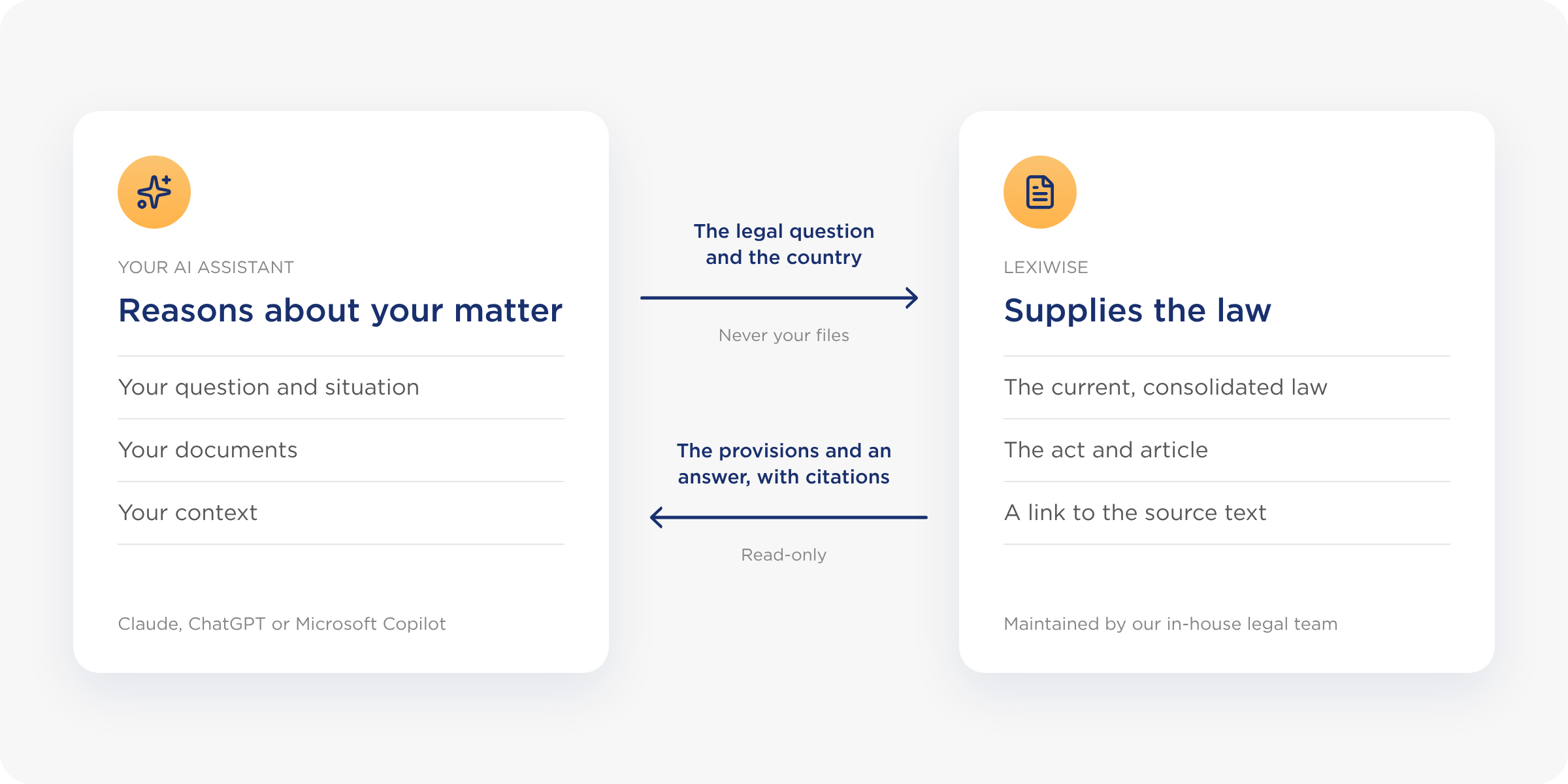
Your assistant reasons, Lexiwise supplies the law
MCP (Model Context Protocol) is the open standard that lets an AI assistant call on outside sources. The Lexiwise MCP keeps a clear line between the two sides:
- Your AI assistant reads your situation, your documents and your context, reasons across them and writes the response.
- Lexiwise supplies what the assistant cannot produce on its own: the current law of the country in question, with the citation.
Two kinds of reasoning about two different things. Your assistant reasons about your matter. Lexiwise reasons about the law: what applies, whether it is current, and where it says so. Think of it as the African-law brain of your AI stack.
The assistant reaches Lexiwise through a small set of tools. Each one returns the law; none of them gives advice.
- ask: an answer to a legal question, written from the statute, with the provisions cited
- search: the provisions that match a topic or phrase, in one country
- get citation: the exact text of a cited provision, with its source
Three sessions, start to finish
1. One country, one question, in English (Copilot)
“Under DRC law, can an employer end a fixed-term employment contract early, and what does it owe the employee?”
Copilot calls Ask Lexiwise for the DRC. The answer comes from the English translation of the Code du travail, cites the articles, and links to the English translation in Lexiwise, where the French original is also available.
2. Several countries in one prompt (Claude)
“Compare the rules on transferring personal data abroad in Senegal, Côte d'Ivoire and South Africa. Put it in a table with the provision for each.”
Claude asks Lexiwise once per country and builds the comparison; every row cites its act and section. Ask about a country that is not yet live and the answer says so, rather than filling the gap from general knowledge.
3. Your document, our law (ChatGPT)
With a draft distribution agreement open: “Check the termination clause against Namibian law.”
The assistant reads your clause in your environment, asks Lexiwise for the Namibian provisions, and flags where the clause departs from them. Lexiwise receives the legal question and the country, not your draft.
Where it works today
Ask Lexiwise, and so the MCP, works where we have consolidated the legislation and prepared it for AI research. Today that is:
- Southern Africa: South Africa, Namibia
- French-speaking Africa: Benin, Burkina Faso, Cameroon, Central African Republic, Chad, Congo, Côte d'Ivoire, Democratic Republic of the Congo, Djibouti, Equatorial Guinea, Gabon, Guinea, Madagascar, Mali, Mauritania, Niger, Senegal, Togo
We add countries as Ask Lexiwise goes live for them. Your account manager has the current list.
Why we did not stop at Ask Lexiwise
Ask Lexiwise already assists users with researching the law in question format, inside Lexiwise. But using it means leaving the assistant your team works in, asking the question again, and carrying the answer back. Your team already has an AI assistant, chosen and approved by your IT and security teams, holding your documents and your context. What it does not have is the current text of Senegalese or Congolese law. So rather than asking your team to come to Ask Lexiwise, the MCP takes Ask Lexiwise to them, and three decisions follow:
- It answers from the statute and does not interpret. Interpretation is your assistant's job, and in the end yours.
- It is read-only. Your assistant can look things up in Lexiwise; it cannot change anything.
- It is the same engine as Ask Lexiwise. The same corpus gives the same answer, whether you ask in Lexiwise or in Copilot.
The same applies to the legal AI platforms your teams or firms may use: they are the reasoning layer, Lexiwise is the African-law layer underneath.
Your data
- Your documents stay in your AI environment. The assistant sends Lexiwise a legal question and the country in scope; Lexiwise returns provisions and an answer with citations.
- Nothing you send is used to train, fine-tune or create embeddings for any model.
- Access is authenticated per organisation, rate-limited and logged.
- You decide who in your organisation uses it, inside your own assistant.
Who can use it
The Lexiwise MCP is available to organisations that subscribe to Lexiwise, for the countries in their subscription where Ask Lexiwise is live. It comes in two forms. Larger organisations license it per organisation and decide for themselves who uses it inside their own assistant. Smaller teams can license it per user, with each person signing in with their own Lexiwise account. Your account manager can advise which fits and set it up for you.
See how it works on the Lexiwise MCP page, or book a demo.
--
This article was written by Steven De Backer, Founder and CEO of Afriwise