

Namibia’s new Investment Promotion Act introduces a framework to reconcile two competing priorities: attracting foreign investment and safeguarding local employment. Section 46, titled Foreign Personnel, is central to this balance. It defines how and when foreign experts can be engaged in Namibian enterprises and under what conditions such engagement remains aligned with national development objectives.
Section 46 empowers the Minister responsible for investments, after consulting with the Ministers of Immigration, Labour and Higher Education, to agree with an investor on the engagement of foreign personnel. This agreement is formalised in writing and where appropriate, incorporated into the performance agreement between the investor and the State. Two categories of engagement are recognised:
- Long-term engagement for positions requiring foreign expertise permanently.
- Temporary engagement for a prescribed period, typically where local skills are unavailable.
Various paths and application steps are detailsed in our Free Namibian Visa and Permit Guides.
This provision is not a blanket authorisation. It is a negotiated arrangement, subject to oversight and embedded within Namibia’s broader investment governance framework.

Namibia’s economic strategy prioritises foreign direct investment as a driver of growth, technology transfer and industrialisation. Yet, the country also faces structural unemployment and a pressing need for skills development. Section 46 creates a controlled pathway for investors to access foreign talent without undermining local workforce development. It is a mechanism designed to prevent abuse while enabling critical expertise to enter the market.
The link to Section 50 is crucial. Where foreign personnel are engaged temporarily, the investor assumes an obligation to train Namibians to assume those roles within an agreed timeframe. This is not aspirational language; it is a statutory requirement. The Act specifies that training must be structured, often through work-integrated learning models such as apprenticeships, ensuring that knowledge transfer is measurable and enforceable.
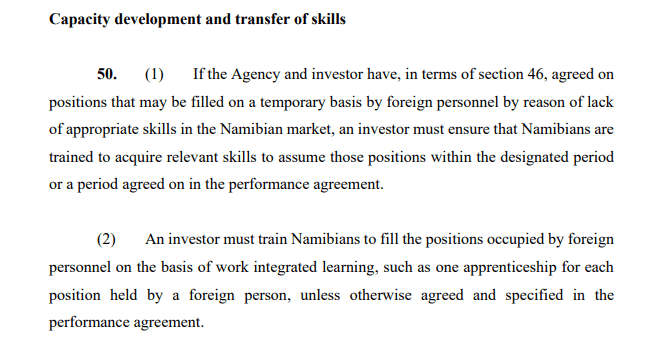
Section 46 sits within Part 7: Investor Rights and Incentives, alongside provisions on visa facilitation (Section 45) and investment incentives (Section 48). Its placement is deliberate. The Act’s objectives, articulated in Section 4, include job creation, skills development and technology transfer. Section 46 operationalises these objectives by linking foreign expertise to local capacity building.
This alignment is reinforced through performance agreements under Section 7. These agreements are not mere formalities; they are binding instruments that define the investor’s developmental obligations. By embedding foreign personnel arrangements within these agreements, Namibia ensures that the engagement of expatriates serves a strategic purpose rather than becoming an unchecked practice.
For CEOs and HR leaders, the implications are significant. Section 46 is not simply an immigration provision; it is an investment governance tool. It signals that Namibia will facilitate the use of foreign expertise when justified, but only within a framework that delivers tangible benefits to the local economy. Investors must therefore approach workforce planning with a dual lens: immediate operational needs and long-term localisation commitments.
Failure to comply is not without consequence. The Act provides enforcement mechanisms, including suspension or withdrawal of investment approvals for contraventions. This elevates compliance from a procedural requirement to a strategic imperative.
Unanswered Questions That Cannot Be Ignored. Will foreign experts, even after being endorsed under Section 46, still find themselves trapped in the same cycle of visa delays, repeated rejections, and opaque administrative hurdles? Does a written agreement between the investor and the State truly dismantle the bureaucratic maze, or does it merely add another layer of paperwork? If Namibia is serious about attracting strategic investment, can it afford a system in which critical talent is stalled at the border while projects wait to be idle? These are not hypothetical concerns; they strike at the heart of execution. A policy that promises facilitation without guaranteeing speed risks becoming a hollow gesture.
Will facilitation evolve into genuine transformation? Section 45 speaks of engagement with immigration authorities, but does that translate into expedited services, predictable timelines, and a seamless process for investors and their personnel? Or will the Immigration Control Act remain the immovable barrier that undermines the intent of the Investment Promotion Act? And beyond entry, what about permanence? If foreign experts commit years of service, transfer knowledge, and contribute to Namibia’s development goals, should there not be a pathway to permanent residence? Or will they remain perpetual outsiders, essential yet temporary, with no stake in the future they help build?
Section 46 is more than a technical clause. It reflects Namibia’s attempt to strike a delicate balance between openness and sovereignty, between global competitiveness and domestic development. For decision makers, the question is not whether foreign expertise can be hired, it can, but under what conditions and with what obligations. The answer lies in understanding that every foreign appointment under this Act is a bridge, not a bypass, a bridge to skills transfer, local empowerment and sustainable growth.
--
Read the original publication at IBN Immigration Solutions


