The Narrative Shift
The National Labour Migration Policy of Namibia is an economic instrument designed to facilitate targeted national growth and structural transformation. To the uninitiated, these regulations may appear as barriers to entry; however, when viewed through the lens of long-term practice and policy evolution, they serve as the foundation for sustained capacity building.
This policy must be understood through the lens of the 2014 SADC Labour Migration Policy Framework, which seeks to align regional and international standards with the specific requirements of Southern African labour markets. For Namibia, the governance of labour migration is intrinsically linked to the broader objective of regional integration and sustainable development.

It reflects a deliberate political and economic rationale in which the entry of foreign expertise is not viewed as an end in itself, but as a mechanism to address specific decent-work deficits and foster an inclusive labour regime.
This policy orientation is further shaped by Namibia’s alignment with the revised SADC Protocol on Gender and Development, which entered into force at a regional level in 2013 and was subsequently strengthened to reinforce gender mainstreaming across labour and economic governance.
Within this context, strategic workforce planning in Namibia is increasingly expected to integrate gender-responsive legislation and the substantive empowerment of women within labour migration and skills-development frameworks.
Demonstration over Assumption
In the current regulatory climate, a non-negotiable shift is evident in which the burden of proof rests entirely with the employer. The concept of rare skills functions as a technical paradox. While an international firm may assume its internal expertise is unique, the Ministry of Home Affairs operates on the principle that scarcity must be rigorously evidenced through a substantial administrative trail.
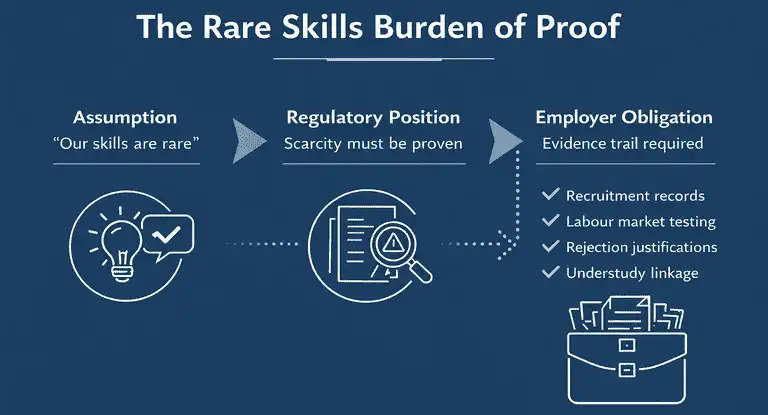
This process begins with the mandatory Employer Representation Form (3-1/0001), which serves as the primary justification for the hire. Employers must now submit complete application files at the outset, typically including the Deed of Surety, certified translations of qualifications, police clearance certificates for applicants over eighteen, medical and radiological reports, photographs certified as a true likeness, and full recruitment documentation.
Any omission immediately slows processing. Official timelines indicate that employment-permit approvals generally take between one and two months for complete submissions and up to two to four months where verification or documentation gaps arise. In practice, these delays have become a defining feature of the system.
A significant regional data gap intensifies this burden. Migration data across the SADC region remains fragmented and inconsistent, and in the absence of a centralised Labour Market Information System, an employer’s recruitment records effectively function as the national proof of skill scarcity. Firms must therefore maintain detailed interview logs, copies of unsuccessful applicant CVs, and documented justification for rejection decisions.
Labour market testing has become one of the strongest regulatory filters: employers must advertise locally, secure confirmation of non-availability of Namibian candidates from the relevant employment authorities, and provide evidence of those recruitment efforts before a foreign national is considered. In practice, this often entails three newspaper advertisements accompanied by labour ministry verification.
In high-skill sectors such as oil and gas, industry reporting has already associated extended work-permit processing with project delays and cost escalations, demonstrating that administrative timelines can directly affect capital-intensive operations.
The Rare Skills Acquisition Plan
To navigate this environment successfully, organisations should adopt a Rare Skills Acquisition Plan as a central workforce-management discipline rather than a peripheral compliance task. This framework aligns foreign recruitment with the statutory obligations of the Affirmative Action (Employment) Act, ensuring that a Namibian Temporary Work Permit functions as a bridge to local capability rather than a substitute for it.
An effective plan integrates proactive succession planning and structured internal knowledge transfer. In practice, this requires the formal design of understudy programmes, where the local professional’s curriculum vitae and qualifications are submitted alongside the expatriate’s application to demonstrate the substance of the transfer.
Baseline procedural requirements include submission of the medical certificate (Form 3-1/0003) and the radiological report (Form 3-1/0004), the latter being specifically required for tuberculosis screening. Yet regulatory scrutiny has moved beyond procedural completeness toward operational substance. The focus now rests on the understudy’s progression.
The Employment Equity Commission expects structured training frameworks containing measurable objectives, defined timelines, monitoring mechanisms and annual progress reporting. Simple declarations are no longer sufficient. Parliamentary guidance has reinforced that genuine skills transfer is a decisive factor in whether renewals are granted, signalling that understudy development is now a regulatory performance metric rather than an administrative attachment.
Implementation Risk
The primary risk in contemporary workforce planning lies in the widening gap between stated intentions and operational substance. Superficial skills-transfer plans are increasingly transparent to regulators, who have shifted from document verification toward inspections that test real localisation outcomes.
There is a discernible rise in site visits during which the presence, development trajectory, and functional role of the understudy are verified. Under these conditions, approvals for permit renewals become significantly more difficult to secure if an organisation cannot demonstrate measurable progress.
Where firms fail to meet these milestones, they enter what may be described as a renewal trap, in which continued reliance on foreign expertise is met with heightened scepticism. Loss of credibility can result in the abrupt withdrawal of key personnel, disrupting operations and undermining investment stability.
Compounding this is a structural reporting challenge. Public commentary has noted that national systems tasked with measuring labour-migration outcomes have struggled to produce consistently updated impact data. This creates uncertainty for employers, who must comply with localisation obligations while operating without fully transparent national indicators against which to benchmark progress.
Correcting Chronic Employer Errors
International firms operating in Namibia frequently encounter avoidable administrative pitfalls that compromise first-pass approval rates. One of the most persistent errors is treating understudy plans and the Deed of Surety (Form 3-1/0005) as static paperwork rather than living management instruments.
Comparative regional experience illustrates the consequences of this approach, where delays, incomplete documentation, and weak procedural discipline have contributed to broader skills-migration bottlenecks and lost employment opportunities. In Namibia, similar outcomes arise when firms omit a single certified translation, fail to document recruitment steps, or neglect to record skills-transfer outcomes in measurable terms.
Another common miscalculation is reliance on precedent. Authorities now expect demonstrable progression from foreign dependency toward local proficiency. Assuming that earlier approvals establish an indefinite pathway for expatriate labour disregards the evolving regulatory emphasis on outcome tracking and the state’s increasing resistance to renewed permits that do not correspond with tangible localisation results.
The 3–5 Year Horizon
Foreign expertise should be positioned as a temporary accelerant, a catalyst for building systems and transferring knowledge, rather than a permanent operational solution.
Over a three-to-five-year horizon, firms are expected to demonstrate a clear transition in workforce composition, moving beyond procedural compliance with immigration law toward substantive alignment with national development objectives. This includes accounting for gender-responsive priorities, ensuring that the benefits of labour migration and specialised training extend across a diverse domestic workforce.
Taken together, the current framework produces a system that is slower, more evidence-driven, and administratively intensive for employers. Yet this design is intentional. It reflects a policy architecture built to enforce localisation, strengthen institutional labour data, and ensure that foreign expertise contributes directly to long-term national capability.
Namibia remains an attractive destination for high-value specialised skills, provided those skills serve the national interest by strengthening sustainable self-sufficiency rather than substituting for it.
--
Read the original publication at IBN Immigration Solutions