

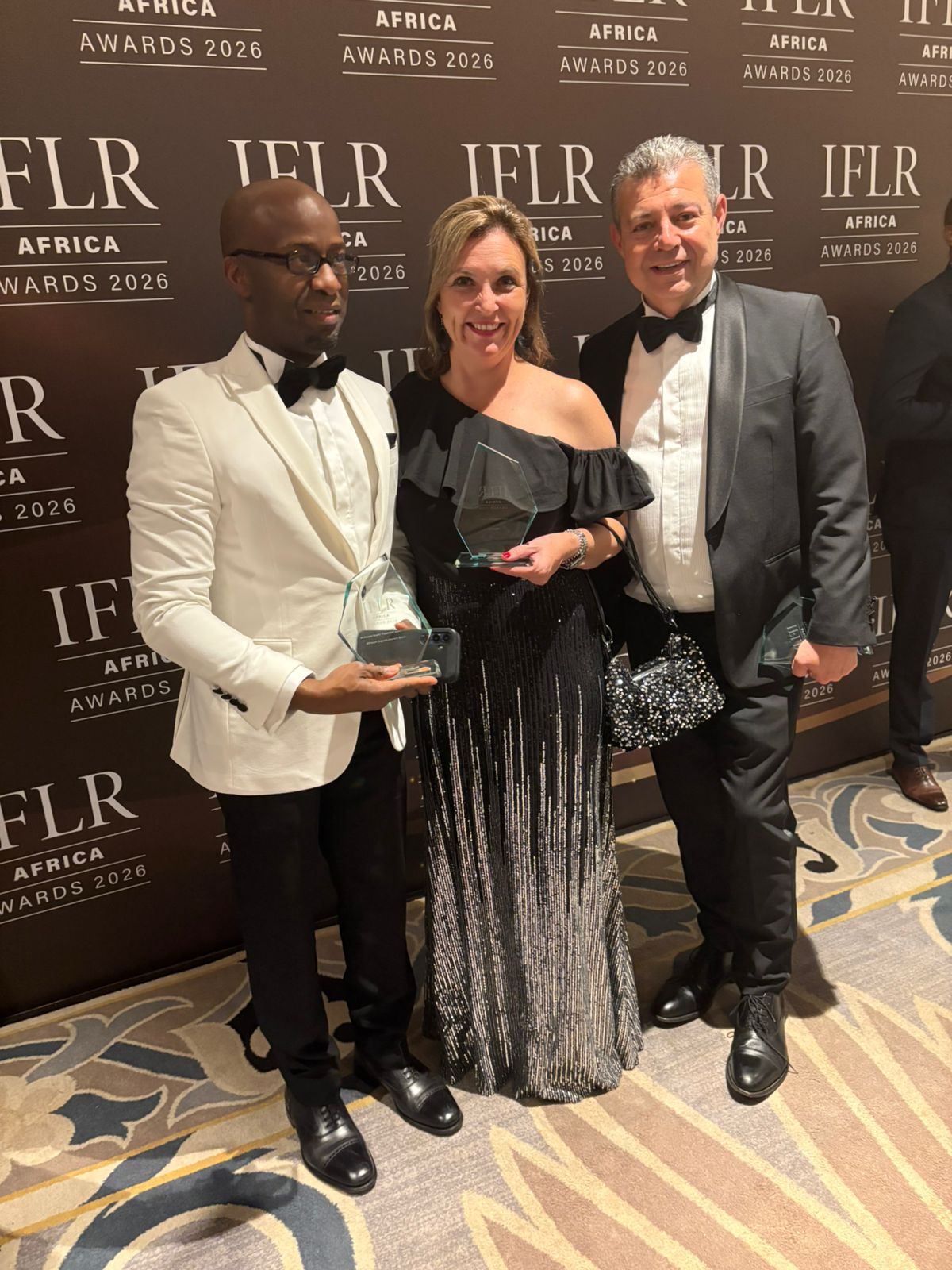
Last Night, at the IFLR Africa Awards ceremony, Afriwise was named the winner of the Africa Tech Innovation Award for the second year in a row.
We'll be honest: we're proud. Back-to-back recognition at one of the continent's most respected legal industry award programmes is not something we take lightly. But the reason we're writing this isn't to celebrate the trophy. It's because of what the award and the work behind it represents for African law.
Before we get into that, there's a second announcement. Steven De Backer, our Founder and CEO, was presented with the IFLR Market Reform Award. He didn't enter. The recognition came from the IFLR community itself. That distinction matters, and we'll explain why.
What We Built
The submission that won this award wasn't about a feature, a workflow, or an AI chatbot. It was about infrastructure.
Over the past several years, Afriwise has been building, layer by layer, Africa's most expansive AI-enabled legal data infrastructure. In 2025, the final components came together. What had previously been separate — structured legislation, regulatory monitoring, compliance automation, a generative AI layer, an enterprise API framework, and a continent-wide network of expert lawyers — was unified into a single, fully operational system.
The result is a machine-readable legal data graph, linking laws, regulations, amendments, case law, compliance obligations, regulatory guidance, and authority behaviour into one queryable, structured, relational infrastructure. It is the first of its kind on the continent.
"It is not a product. It is the foundational layer on which all future legal, regulatory and compliance innovation in Africa can be built."
On top of that graph, we built a proprietary layer enabling generative AI to operate safely over verified legal data. We integrated Sentinel's regulatory intelligence engine, launched an enterprise-grade API framework and embedded our network of more than 200 African law firms directly into the platform. The machine precision is always grounded in human expertise.
.jpeg)
The Problem We're Solving
To understand why this matters, you need to understand what happens when it doesn't exist.
Right now, global AI systems are being asked questions about African law every day. When those systems can't access structured, verified primary sources — when African legal data isn't in the dataset — they don't say "I don't know." They fill the gap. They pull from blogs, secondary commentary, assumptions. They borrow from other jurisdictions. They generate answers that look authoritative and are quietly wrong.
"Law is becoming data. Africa must not be missing from the dataset."
This is not a hypothetical risk. We demonstrated it in our submission: a query to a generic AI system about employment contract law in the Democratic Republic of Congo returned materially inaccurate information — because the primary source data simply wasn't available to it. For a general question, that's a nuisance. For a company making investment or compliance decisions, it's a liability.
The competitive gap in African legal AI does not come from the quality of the AI model. It comes from the quality of the data the model has access to. That is the problem Afriwise is solving.
What the Consecutive Win Tells Us
Winning the IFLR Tech Innovation Award two years running is not something that happens by accident. And we think the consistency of the recognition says something worth paying attention to.
The 2025 award validated that we had built something technically credible — that the architecture was sound, the vision coherent, the ambition grounded. The 2026 award, based on a year in which that infrastructure became fully operational, validates that credibility has become consequence.
.jpeg)
On Steven's Market Reform Award
The IFLR Market Reform Award is given to a single individual whose work has improved the state of financial markets and the conditions for investment. The award reflects accomplishments in bringing to market or shaping, advancing or influencing significant regulatory advancements, and developments in legal market infrastructure.
Steven did not put himself forward for this award. It was nominated and decided upon entirely within the IFLR community. We think that matters. Recognition that isn't solicited is a different kind of signal.
It also maps closely to what we believe about the connection between legal infrastructure and market conditions. If investors, companies, and institutions are to operate in African markets with genuine confidence, they need to be able to understand the legal environment clearly, in real time, across jurisdictions. The data layer we have built is not a nice-to-have. It is a condition for that confidence.
The IFLR community sees the work in those terms; as market reform, not just legal technology. This is exactly the framing we believe is right.
What Comes Next
We are at the beginning of a decade that will fundamentally reshape how law is practised, interpreted, and operationalised. AI-driven platforms are becoming systems of action. Law firms are restructuring around data and knowledge rather than hours. Regulatory bodies are beginning to think in machine-readable terms.
Africa has a choice to make right now, not in five years. It can build the data layer that ensures African law is represented accurately in the global AI transition. Or it can allow that transition to happen around it, with African legal frameworks filled in by assumption and inference.
We have spent years building the infrastructure to make the right choice possible. Last night's recognition tells us we're doing it right.
There is a lot still to build. We're ready. We’re building it.
Want to understand how Afriwise's infrastructure could work for your organisation?
Visit afriwise.com or reach out to our team at info@afriwise.com


.jpg)